A water pipe is tangible. The records needed to replace it are less so. Someone has to establish what the pipe is made of, where it runs and which property it serves before a contractor can price the work. The construction photograph comes later.
For anyone allocating money to public health or community infrastructure, that sequence matters. A funded project still needs people and systems capable of turning its budget into a set of decisions.

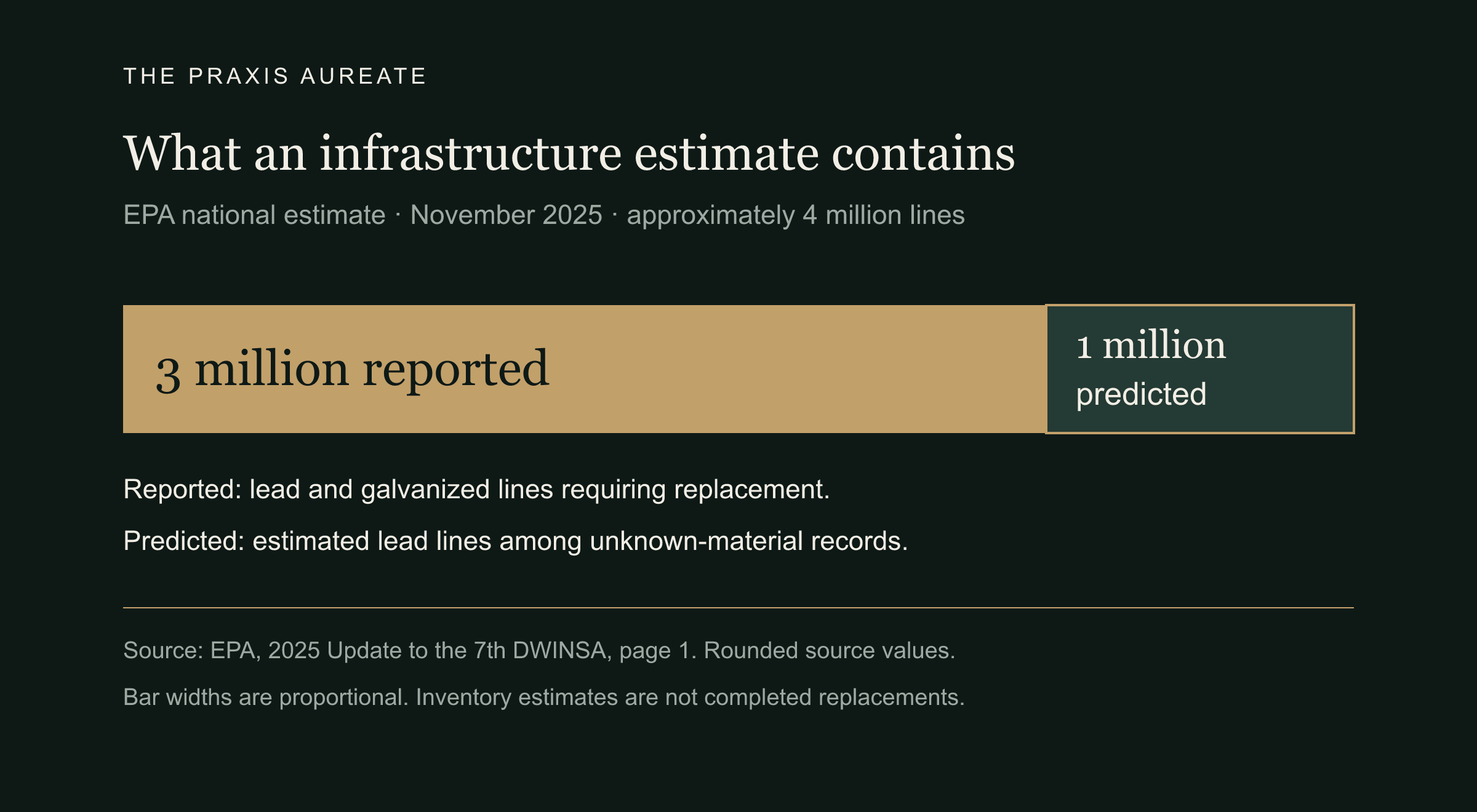
Start with a number that looks straightforward. In November 2025, the U.S. Environmental Protection Agency (EPA) estimated roughly 4 million lead service lines. The estimate combines about 3 million reported lines, including galvanized pipes requiring replacement, with 1 million predicted among lines of unknown material. The total joins records and a model. It does not represent 4 million individually confirmed lead pipes. 1
The distinction affects funding. EPA uses these estimates to help determine state allotments. In this calculation, a missing system inventory was treated as non-lead; reported unknown materials were modeled using a state-specific ratio. Missing information and confirmed material are different things, even when a formula gives them similar treatment. 1
The budget before the build
EPA’s funding guidance recognizes preliminary work. Identification, planning and design can qualify alongside replacement, subject to program requirements. The infrastructure law appropriated $15 billion for lead service-line replacement through the Drinking Water State Revolving Fund. It directs 49 percent of those funds to grants or principal-forgiveness loans. That is a program-wide allocation, not a promise that every applicant receives that share. 2
My reading is that this creates a useful question for foundations and community partners: what is preventing a local project from becoming ready to deliver?
The answer might involve incomplete records, resident outreach or preparation of an eligible application. It might also be contractor availability or a financing constraint. The purpose of asking is to identify the actual obstacle before deciding what support to offer. A grant for administrative capacity is worth considering when the missing capacity has a specific job to do.
There is a public-data starting point. In August 2026, EPA expanded its Water Infrastructure and Capacity Assessment Tool with demographic measures including renter share and the proportion of young children. The tool brings community characteristics together with utility, compliance and funding data to help screen for potential assistance needs. 3
That combination is useful because a utility’s engineering problem and the community’s ability to navigate a project are related questions. A high renter share, for example, could prompt a project team to ask how it will communicate with both owners and residents. It does not establish that communication is failing, or that any particular home has a lead pipe.
The map is a starting point. EPA calls for local verification, and some utilities lack adequate geographic data. 3

Before approving another project budget, I would ask for a short list of unresolved decisions, the person responsible for each and the money available to resolve it. Who verifies pipe material? Who coordinates access? Who moves the inventory into design and purchasing?
Those questions apply beyond water. A housing award, a new health program or a technology purchase can also leave necessary implementation work unassigned. The comparison is an operating principle, not a claim that the projects face identical constraints.
Better records will not solve every delivery problem. They can make the remaining problem easier to name. Before celebrating the shovel, inspect the ledger that tells the crew where to dig.
Sources
Sources checked .
- EPA, 2025 update to the seventh Drinking Water Infrastructure Needs Survey and Assessment , November 2025, pages 1 and 3.
- EPA, Identifying federal funding sources for lead service-line replacement , updated September 2, 2026.
- EPA, Water Infrastructure and Capacity Assessment Tool , August 2026 data update.