Updated : dates made explicit and the U.S. Energy Information Administration (EIA) citation pointed to the archived September outlook. Updated : photo credits condensed. Updated : figure caption clarified and duplicate note removed. No figures changed.
The next AI planning meeting may need a facilities director.
Much of the conversation about artificial intelligence concerns what happens on a screen. Can the software write a report? Answer a patient’s question? Save someone an afternoon? Those are reasonable questions. But someone also has to supply the electricity.

That part of the story deserves more attention from people who run hospitals, schools and community organizations. A technology expansion can become a question about infrastructure, operating budgets and whether essential services can keep running.
In its September outlook, the U.S. Energy Information Administration (EIA) forecasts electricity sales of 4,135 billion kilowatt-hours in 2026 and 4,211 billion in 2027. Data-center development and manufacturing help explain the growth. These are national forecasts, not results already in hand. 1
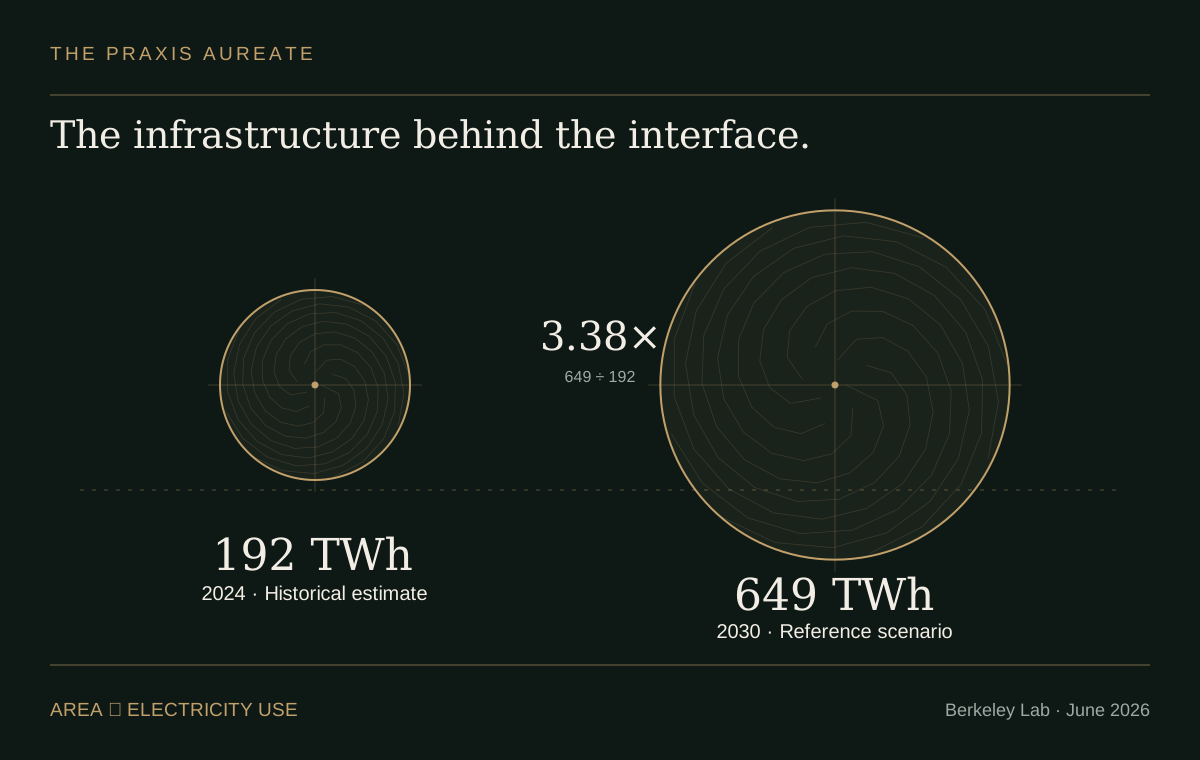
A second report gives the scale some shape. Berkeley Lab estimates that U.S. data centers used 192 terawatt-hours in 2024. Its reference scenario reaches 649 terawatt-hours in 2030, about 3.38 times as much. The comparison covers data centers generally, not AI alone. And the larger number depends on the model’s assumptions. 2
I would resist turning those numbers into a prediction about anyone’s electricity bill. They cannot tell us whether a particular data center will raise local rates, who will pay for new infrastructure or what efficiency improvements might offset demand. For that, we need the utility filing and the regulator’s decision.
Still, the national picture gives us a reason to ask better local questions.
Follow the operating budget
Consider a cooling center. Paying for the equipment is one decision. Keeping it staffed, maintained and supplied with electricity is another. California’s heat guidance identifies children, older adults and people with chronic conditions among those especially sensitive to heat. Reliable cooling is part of the service those residents need. 3

The connection to the AI buildout is a planning question: how will communities provide dependable capacity for several kinds of demand at once?
A foundation weighing a facility grant could ask to see the operating budget alongside the capital request. A hospital or nonprofit could put its utility costs, contract dates and electricity-dependent services on one page, then have finance and facilities read it together. A public buyer could ask a supplier which projected savings have actually been measured.
These are modest steps. They bring an often distant technology story into decisions an organization can make now, using bills, contracts and plans it already has.
They also help separate an attractive purchase from an affordable service. Equipment can be funded once. The work it makes possible needs a budget every year.
For homeowners and parents watching a local infrastructure proposal, I would start with the same questions: who pays, what assumptions support the price and how are essential services protected? National forecasts are useful context. The answers will be in local documents.
These figures come from EIA’s September 2026 outlook; its October outlook is under review for a later update. I’ll be watching how the forecast is revised and which local decisions give those revisions meaning. 1
The AI gold rush has an operating budget. It is worth reading before the bill arrives.
Sources
Sources checked .
- U.S. Energy Information Administration, September 2026 Short-Term Energy Outlook, September 9, 2026.
- Lawrence Berkeley National Laboratory, Smith et al., United States Data Center Energy Usage Report: 2025 Update, June 18, 2026.
- California Department of Public Health, CDPH Guidance for Local Health Jurisdictions and Community Service Providers for Extreme Heat, July 1, 2024.