A larger public arts budget invites organizations to imagine what they could make possible: another workshop, a longer season, a place for young people to create. Turning that possibility into a dependable commitment requires a calendar alongside the award amount.
There are distinct questions inside the apparent good news. How long will the support last? What has actually been awarded to this organization? When will the money be available to pay for the work?

California offers a timely example. In its October 2 analysis of the adopted spending plan, the Legislative Analyst’s Office (LAO) reports a $106.2 million California Arts Council budget for 2026 to 2027. The analyst attributes most of the increase over the revised prior year to $68 million in one-time grants. That is budget authority, not evidence of money already received by arts organizations. The LAO analysis also distinguishes agency-directed grants from direct grants to named institutions and activities.
The distinction matters before anyone writes a larger annual operating plan. One-time support can be well suited to a finite production, a defined project or a temporary expansion. It becomes a different proposition when a board uses it to support commitments that continue after the funding ends. My reading is that the useful question is how the duration of each commitment matches the duration of its funding.
A calendar inside the award
A separate Arts Council program makes the timing question concrete. The Arts and Youth calendar lists an activity period from October 1, 2026, through September 30, 2027, with funds estimated to arrive between January and March 2027. The program guidelines corroborate those dates. This schedule is an example of grant administration; it does not establish how the new one-time budget allocations will be paid.
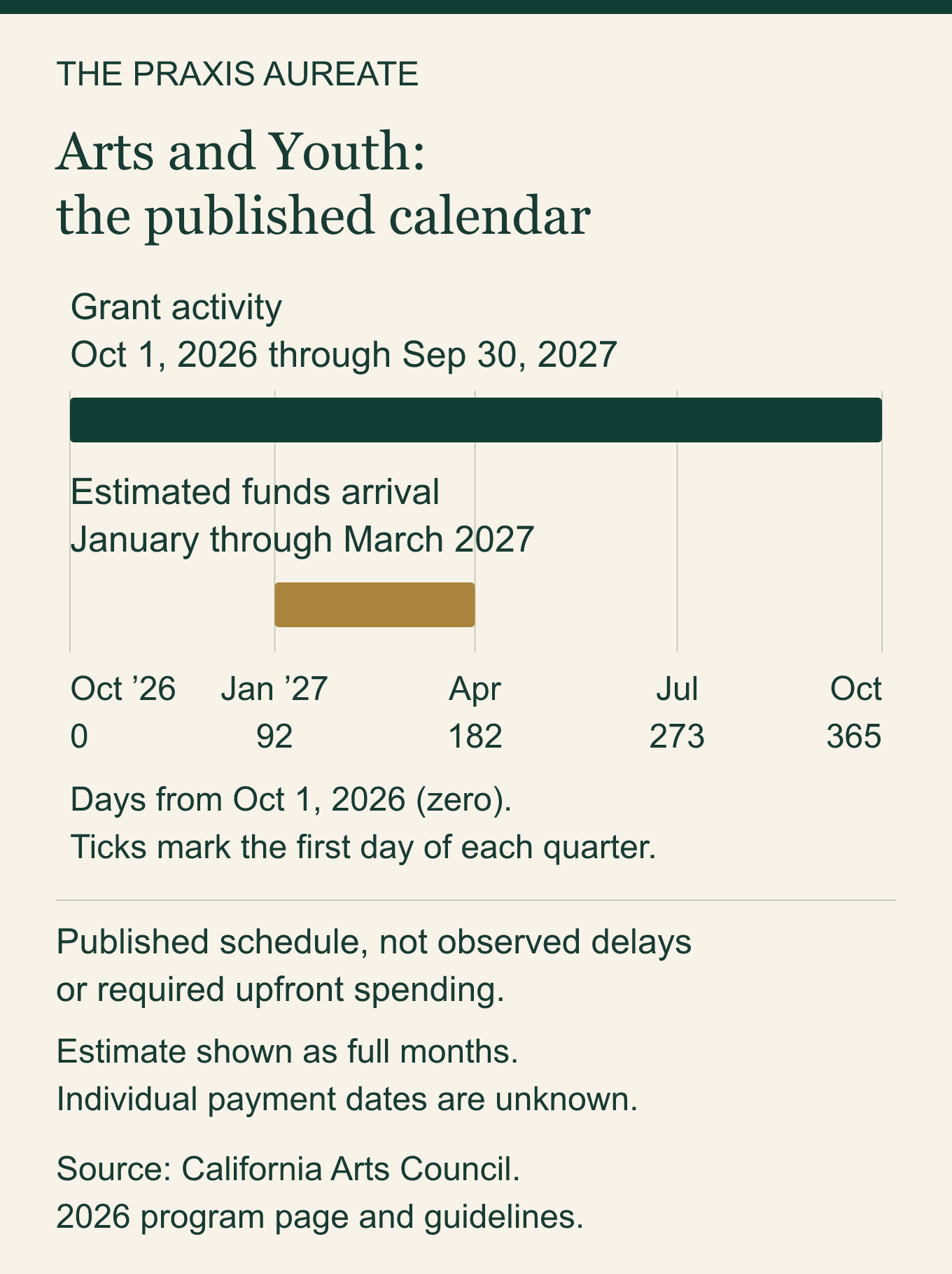
An activity period beginning before expected receipt does not prove that payment is late. It does not show that every recipient must spend immediately, either. An organization could plan its work after receipt, have suitable cash available or follow award terms that change the practical calculation. The published calendar alone cannot tell us which case applies.

If costs do fall due before the grant arrives, however, something else must cover them. Those calendar decisions shape what an organization can responsibly promise. The amount of support matters, but so do the sequence of obligations and the resources available when each payment falls due. Without an actual spending plan and award agreement, there is no defensible estimate of a financing gap.
For an arts executive and board, I would put the program schedule beside a month-by-month cash forecast before approving new commitments. Show expected receipts separately from confirmed receipts, identify which funds can properly cover each expense and name the decision that changes if the expected arrival moves. That makes uncertainty a matter for deliberate management.
A foundation considering complementary support could start with the same calendar. Perhaps flexible support would let a grantee retain its intended schedule; perhaps the organization has already matched its work to the available cash. Asking reveals more than assuming that every award creates an emergency or that every recipient needs a loan.
The next concrete checkpoint is the agency’s estimated payment window. As it approaches, the useful evidence will be any revised guidance and each recipient’s confirmed payment information. The calendar is a published expectation, not an observed result. For the people organizing a workshop, the value of that distinction is practical: it helps them decide when they can responsibly promise that the room will open.
Sources
Sources checked .
- California Legislative Analyst’s Office: The 2026-27 California Spending Plan: Other Provisions , October 2, 2026; California Arts Council section.
- California Arts Council: Arts and Youth , Program Timeline for the 2026 Arts and Youth cycle.
- California Arts Council: Arts and Youth 2026 Grant Guidelines , printed page 3.